
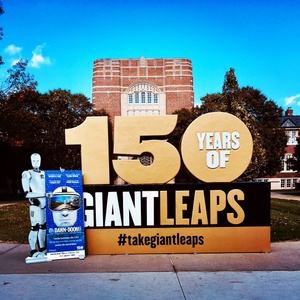
I had a unique opportunity to listen to Jaron Lanier speak as the closing keynote to the 2018 Dawn or Doom Conference At Purdue university. Since it was election day, Jaron began by encouraging anyone who hadn’t voted to leave and go vote. Lanier introduced his talk with reference to you being mentored by one of the early computer scientists, Marvin Minsky. He noted the debates he used to have with Monday over use of the term “Artificial intelligence.”
“ I’m criticizing the philosophy and the framing and the Narrative around artificial intelligence…”the algorithms are great, but they are not artificial intelligence.
He went on to say that artificial intelligence is this the story we tell ourselves about what is being done with algorithms. “ what about the storytelling around the code”
Jaron Lanier went into a story about when Marvin Minsky work with Noam Chomsky in the 1950s they assign students to translate language over the summer. This is funny to the audience who laughed as it is, knowledge that this is a complex problem, but will near went on to explain that they have no idea how complex the problem would be at the time. He explained it that much later IBM got the idea to use big data unless using the archives of the United Nations translators. This worked, but, “you think you got the translator to work it would work ….” as most computer systems do, “but language is alive.”
He went on to talk about the ethics of solving this problem as the companies you have to update these translation algorithms are scraping data from unknown users without compensation or recognition. This has been floating in my mind now every time I hear a translation for free or talk to anyone about MS Azure.
Lanier went on to cite the concept of destructive invention, but noted that he thinks this is worse. This is putting translators out of work. In essence, the companies are saying, “We still need you but we’re not going to admit we need you”. He insists that instead of making these people obsolete, we should acknowledge them and the fact that the future needs them in a new way.
All of this sets up a central idea held by Lanier, “In order to create fake people, you have to devalue actual people of their personhood” ….for Lanier, “fake people are a bad thing”.
Jaron Lanier frequently references the idea of personhood, saying personhood fills the gap to understanding the world. It was a touch of the supernatural and Lanier confesses that he would hate to think that as a parent he is just raising a tiny flesh robot.
He went on to criticize the concept of machines being used as fake humans, mocking the idea that we create algorithms and then ask ourselves, “Is this tiny piece of tech I making kind of like a person”
This of course opened up in discussion of Alan Turing during what he recommends all of us read Turing’s notes in which he invented the Turing test. Jaron Lanier Insists that we have to understand the true test in the context of the fact that this man was pivotal in defeating fascism was led to his demise by fascism. Perhaps these questions that Turing ask her more about humanity being like machines, than they were about machines themselves.
Questions that lead to the question, “can humans make themselves seem stupid to make the machine seem smart? It’s happening! Algorithms decide what news we see everyone is less informed we have echo chambers. We have dating apps to it she says “I mean come on?”
My questions: ”How far are we from algorithms to augment our intelligence”
Is it possible to maintain real online relationships but avoid the feedback loops
This entire talk was riveting and one of my favorites points from the top was when Jaron Lanier notes that Marvin Minsky and he were going to present to the National Science Foundation requesting money for their research, Lanier didn’t Want to use the term artificial intelligence. But Minsky told him if you if we want to get the money we are more likely to get it if we use this term. So essentially, calling these algorithms artificial intelligence was a funding storytelling action.
Jaron Lanier Is clear on the fact that he is not against artificial intelligence, because how can one be against an algorithm, it is only a tool. What He is opposed to is the Farias uses of algorithms. You know it’s that and the majority of cases these algorithms are being used to manipulate actual human beings.
In the use of algorithms to detect trends and manipulate humans it’s important to note that positive emotions such as encouragement support affection or harder to reinforce whereas negative emotions like paranoia anger and distrust rise faster. For example it takes a long time to increase positive emotions like building trust or love, But it is easy to lose trust and to lose love. In other words, it is easier to hurt than to help.
Jaron Lanier Close to the idea of a circle of empathy. A circle of empathy is the small group of things and individual is willing to give more empathy towards. Linear notes there were times that I didn’t include black people or women and this is still the case and some texts or calls circle of empathy. But the most dangerous thing Jaron Lanier notes about the circle of empathy is when people with power plays tech objects are algorithms of their creation inside of the circle of empathy. For example, he stated the incidence of giving citizenship to a robot well there are still women in Saudi Arabia with less rights than this Romanian robot.
Not only did linear talk give Insight into a good deal of wisdom from his years of experience in the industry, it also gives us pause as we move forward with tech development. The stock should not be considered just a meeting of the minds but instead a call to action for people with influence and the tech sector.
Some random quotes by Jaron Lanier, “If experience itself is an illusion it doesn’t matter it’s still has rules but has different properties”
Jaron Lanier “The concept of using computers to control humans is older than computers” He notes to texts that are relevant first there is the machine stops by Ian Forrester, 1907. Next there is the human use of human beings by Norbert Wiener, read that too.
Aleshia Hayes
 Goody Two Shoes Media
Leave a comment